
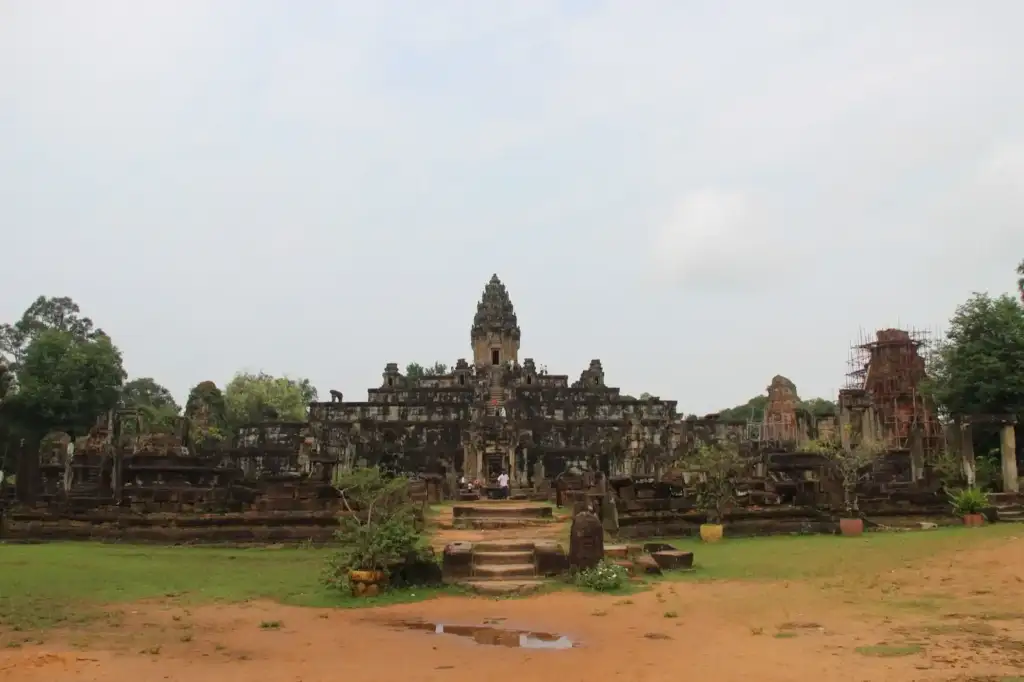
The Roluos Group (រលួស) is where Angkor began. About 13 km south-east of Siem Reap lie the remains of Hariharalaya, the royal city that came before Angkor, and three temples built there in the late 9th century: Preah Ko, Bakong and Lolei. They are older than Angkor Wat by more than two centuries, included in the Angkor Pass, and usually quiet.
Compare passes, pick a route and find every temple guide in our Angkor travel guide.
Opening hours are set by Angkor Enterprise and the APSARA National Authority. Its site lists 7:30 am to 5:30 pm for most temples, though some sources report longer hours since 2024. Restoration work continues at Preah Ko, Bakong and Lolei, so scaffolding or closed sections are possible. Details below were checked on 15 November 2026.
Conditions now
Roluos Group
28°C
Overcast · feels like 32°C
- Humidity 74%
- Wind 4 km/h
- Air: Moderate (AQI 56)
- TodayDrizzle33° / 24°35% rain
- WedDrizzle32° / 25°46% rain
- ThuDrizzle32° / 23°16% rain
- FriDrizzle33° / 24°37% rain
- SatShowers32° / 24°81% rain
Updated hourly. Forecast and air quality by Open-Meteo.com (CC BY 4.0). Conditions can change quickly in the wet season.
The capital before Angkor
In the 9th century, King Jayavarman II brought the Khmer lands together and ruled for part of his reign from Hariharalaya, near today’s village of Roluos. He died there in 835. It was the first Khmer royal city north of the Tonle Sap lake, and it stayed the center of the kingdom for most of the 9th century.
The temples you visit today were built by two later kings. Indravarman I, who ruled until 889, dug a great reservoir, the Indratataka, about 3.8 km long, and built Preah Ko and Bakong. His son Yasovarman I added Lolei, then moved the capital north to found Yasodharapura, the first city at Angkor. Many ideas you see later at Angkor, from the temple-mountain to the great reservoir, appear here first.
The three temples
Preah Ko (879)
ប្រាសាទព្រះគោ, “the sacred bull”. Six brick towers on one platform honor royal ancestors: the front three for Jayavarman II and Indravarman’s father and grandfather, the rear three for their wives. Three stone Nandi bulls face them.
Bakong (881)
ប្រាសាទបាគង, the state temple of Indravarman I and the first great temple-mountain: a five-tiered sandstone pyramid within two moats, with stone elephants at the corners of the lower tiers.
Lolei (893)
Built by Yasovarman I on an island in the middle of the Indratataka, now dry. Four brick towers honor his parents and grandparents. A working Buddhist pagoda surrounds them.
Tickets
The Roluos temples are part of the Angkor Archaeological Park and included in the Angkor Pass; there is no separate ticket. Keep your pass with you for checks at each temple.
| Pass | Price (foreign visitors) | Validity |
|---|---|---|
| 1 day | US$37 | One day |
| 3 days | US$62 | Any three days within 7 days |
| 7 days | US$72 | Any seven days within 30 days |
Prices last checked: 15 November 2026. Angkor Pass prices can change. Confirm the current price on the official Angkor Enterprise site. The Angkor Wat guide explains where to buy.
When to go
Morning
Early start
Cool and quiet, and a good way to begin a pass day before the main temples get busy.
Afternoon
From 3:00 pm
Warm light on Preah Ko’s brick and Bakong’s sandstone. Finish at Bakong for a calm sunset away from the crowds.
Order
Oldest first
Visit Preah Ko, then Bakong, then Lolei to follow the story in the order it was built.
Getting there
Roluos is about 13 km south-east of central Siem Reap along National Road 6, a 20 to 30 minute ride by tuk-tuk or car. Preah Ko and Bakong are a short drive south of the main road, and Lolei is just north of it. Most drivers visit all three in a half day; see getting around Cambodia.
Roluos is in the opposite direction from the main temples, so it works best as a separate half day, or combined with a trip to the Tonle Sap lake to the south.
A route through the group
- Start at Preah Ko. Look at the three Nandi bulls, then the towers up close: patches of the original lime stucco still cling to the brick, and the carved lintels are among the finest of their period.
- Drive a few minutes south to Bakong. Cross the causeway, where seven-headed serpents line the way over the moat.
- Climb the five tiers of the pyramid, passing the stone elephants, which grow smaller toward the top. The tower at the summit was rebuilt two to three centuries after the temple was founded.
- Walk around the brick towers that ring the pyramid and the modern pagoda close by.
- Finish at Lolei, north of the road. Look for the inscriptions carved on the door frames and the pagoda buildings around the towers.
What to look for
Brick and stucco
Before sandstone took over, Khmer builders worked in brick finished with carved lime plaster. Preah Ko shows how fine that work could be.
Inscriptions
Lolei’s door frames carry long carved inscriptions, records of the foundation and the people and goods given to support it.
The first temple-mountain
Bakong’s stepped pyramid is the model for later state temples, from Pre Rup to Angkor Wat.
Restoration at work
German and Cambodian teams have restored towers at Preah Ko since the 1990s, and work continues at Lolei and Bakong. New brick shows where gaps have been filled.
Visit with respect
Lolei and Bakong sit beside active pagodas, so dress modestly, keep your voice down near monks and remove shoes and hats if you go into a pagoda building. Use the stairs and paths on Bakong rather than climbing the walls, and do not sit or stand on carvings.
Frequently asked questions
Is the Roluos Group included in the Angkor Pass?
Yes. Preah Ko, Bakong and Lolei are part of the Angkor Archaeological Park and covered by every Angkor Pass.
How old are the Roluos temples?
They date from 879 to 893, more than 200 years before Angkor Wat, which was built in the first half of the 12th century.
How long do you need at Roluos?
Two to three hours for all three temples, including the drive from Siem Reap.
Is Roluos worth visiting?
Yes, especially on a second or third day. It shows where Angkor’s ideas began, it is close to town and it is far less crowded than the main temples.
Sources: history, dates and dedications from Maurice Glaize’s Angkor guide (Preah Ko, Bakong, Lolei) and Wikipedia; restoration from the APSARA National Authority; opening hours from Angkor Enterprise and The Star. Last checked 15 November 2026.