
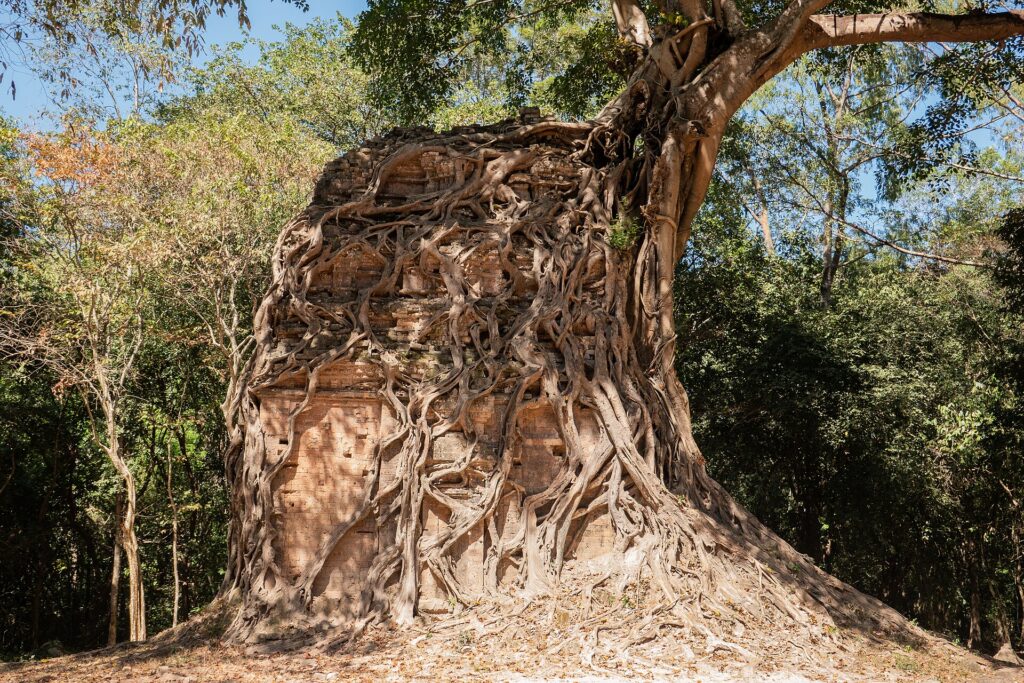
Sambor Prei Kuk places pre-Angkorian brick temples within a quiet forest landscape. It offers a different architectural vocabulary and pace from the monumental sandstone complexes around Siem Reap.
Ancient Ishanapura
The site is identified with Ishanapura, capital of the Chenla Empire in the late 6th and early 7th centuries. UNESCO describes more than one hundred temples, including rare octagonal examples, and an artistic style that helped lay foundations for later Khmer architecture.
How to visit
Kampong Thom is the practical base for a focused visit. Allow two or three hours among the principal groups, longer if you enjoy slow architectural observation. Forest paths, heat and seasonal rain call for suitable shoes and water.
Look at material and form
Notice fired brick construction, sandstone architectural details, lintels, small sanctuary scale and the relationship between separate temple groups. Do not climb fragile structures or remove even an apparently loose fragment.
Useful reading
UNESCO World Heritage Centre: Sambor Prei Kuk
Walk the forest as part of the site
Sambor Prei Kuk is experienced through paths, trees and groups of brick sanctuaries rather than one dominant monument. Allow the landscape to unfold gradually. The shade is welcome, but roots and uneven surfaces require attention.
What to notice
Look for the differing plans of temple groups, surviving brick detail and the relationship between architecture and the forest setting. A knowledgeable local guide can help distinguish original features, later change and modern restoration without turning uncertainty into certainty.
Planning from Kampong Thom
Kampong Thom is the practical base for an unhurried visit. Confirm transport and current opening arrangements locally. Travellers crossing between Phnom Penh and Siem Reap should avoid treating the site as a rushed roadside pause; an overnight stop gives it better context.
Low-impact visiting
- Do not climb brickwork or step across protective barriers.
- Keep food away from monuments and carry rubbish out.
- Ask before photographing guides, vendors or nearby residents.
- Give cyclists and pedestrians room on narrow approaches.