
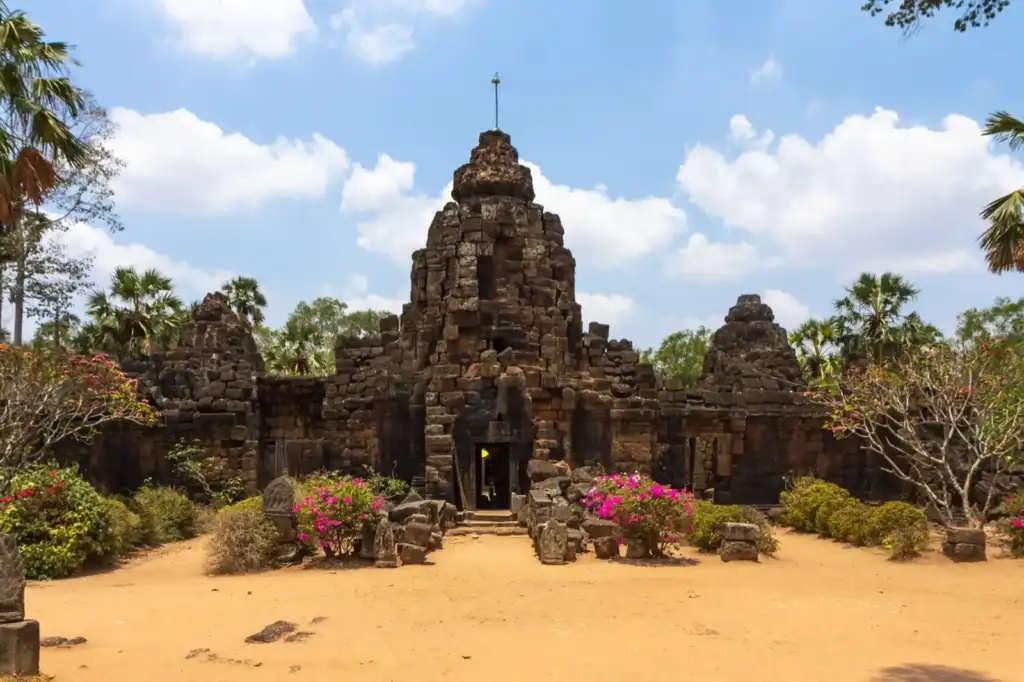
South of Phnom Penh, two Angkor-era temples make an easy day out from the capital. At Tonle Bati (ទន្លេបាទី), a carved 12th-century temple stands near a lake where Cambodian families picnic on weekends. At Phnom Chisor (ភ្នំជីសូរ), a long stairway climbs to an 11th-century hilltop temple with one of the widest views in the south.
Both sites charge a small entry fee for foreign visitors, collected locally. Fees and hours are not published officially, so bring small US dollar or riel notes and ask at the entrance. Details below were checked on 15 November 2026.
Conditions now
Tonle Bati and Phnom Chisor
28°C
Overcast · feels like 33°C
- Humidity 73%
- Wind 6 km/h
- Air: Moderate (AQI 72)
- TodayOvercast33° / 25°63% rain
- WedDrizzle32° / 25°3% rain
- ThuDrizzle32° / 25°12% rain
- FriDrizzle33° / 25°63% rain
- SatShowers31° / 24°98% rain
Updated hourly. Forecast and air quality by Open-Meteo.com (CC BY 4.0). Conditions can change quickly in the wet season.
Tonle Bati
Ta Prohm of Tonle Bati
This Ta Prohm shares its name with the famous forest temple at Angkor and comes from the same reign. It was built under King Jayavarman VII in the late 12th or early 13th century as a Buddhist sanctuary, in the Bayon style, and was altered as late as the 16th century. It is small enough to walk around in half an hour, but its carving is the reason to come: female deities on most walls, several finely decorated lintels, one of them very well preserved, and a seated bodhisattva on the western pediment. Inside stand images of the Buddha.
Yeay Peau
About 150 meters north, in the grounds of the active Wat Tonle Bati, stands Yeay Peau, a single sandstone tower. Its name means “Lady Peau”, and a local legend explains it. Peau was loved by a king, Preah Ket Mealea, and bore him a son, Prohm. Years later the grown son did not recognize his mother and wished to marry her. She challenged him to a contest to build a temple overnight and won by lighting candles that made Prohm’s side believe dawn had come. He then had to accept her as his mother. The two temples, Ta Prohm and Yeay Peau, are said to be the result.
The lake
The temples sit near the Tonle Bati lake, a favorite weekend outing from Phnom Penh. Families spread out on mats and bamboo platforms by the water, buy food from stalls and relax for the afternoon. On weekdays it is quiet; on Sundays and holidays it is busy and lively.
Phnom Chisor
Phnom Chisor is a 133-meter hill rising from the rice fields of Takeo, crowned by a temple once called Sri Suryaparvata, “mountain of the sun”. Inscriptions date it to the reign of King Suryavarman I in the early 11th century (1017 and 1019 are recorded), about a century before Angkor Wat. It was dedicated to Shiva.
The temple is built mainly of brick on laterite bases, with sandstone lintels and door frames. Some towers have collapsed and others stand partly ruined around a central sanctuary. A modern pagoda, rebuilt in 1979 after destruction in the 1970s, shares the summit.
The climb is part of the visit. Two stairways lead up the hill, with several hundred steps each; counts vary from about 400 to 600 depending on the route. At the top, the view stretches across the plain. Below the hill, a line of ruined gateways, Sen Thmol and Sen Ravang, leads out to the ancient pool of Tonle Om. Sen Ravang now shelters a reclining Buddha.
When to go
Morning
Climb early
Do Phnom Chisor first, before the midday heat. The stairs have little shade, and the light over the plain is clearest in the morning.
Lunch
Tonle Bati lake
Finish at Tonle Bati for the temples and a long lunch by the water, as many Cambodian families do.
Season
November to February
The cooler dry months are the most comfortable for the climb. After the rains, the fields around Phnom Chisor are brilliant green.
Getting there
Both sites lie off National Road 2, which runs south from Phnom Penh toward Takeo town. Tonle Bati is about 35 km from the city. Phnom Chisor is further south: its turnoff from the main road is around the 52 km mark. With traffic out of Phnom Penh, allow about an hour to Tonle Bati and another 30 to 40 minutes on to Phnom Chisor.
Public transport does not serve the sites well. Most visitors hire a car and driver or a tuk-tuk for the day; see getting around Cambodia. For a longer day, the route also passes near the Phnom Tamao wildlife center, and further south lie the pre-Angkor sites of Angkor Borei and Phnom Da (see our Takeo guide).
Visit with respect
Both temples share their grounds with active Buddhist pagodas. Cover shoulders and knees, take off shoes and hats before entering pagoda buildings and keep your voice low near monks and people praying. Do not climb on the ruins. On Phnom Chisor, carry water, wear shoes with grip and take the stairs slowly in the heat.
Frequently asked questions
Can you visit Tonle Bati and Phnom Chisor in one day?
Yes. Start early with Phnom Chisor, then visit Tonle Bati on the way back to Phnom Penh. It makes a relaxed full day, or a busy half day.
How far is Tonle Bati from Phnom Penh?
About 35 km south on National Road 2, roughly an hour by car depending on traffic.
How many steps are there at Phnom Chisor?
Several hundred. Published counts range from about 400 to 600, depending on which of the two stairways you use.
Is this the same Ta Prohm as at Angkor?
No. Both were built in the reign of Jayavarman VII and share a name, but the famous tree-covered Ta Prohm is at Angkor, near Siem Reap. See our Ta Prohm guide.
Sources: history, inscriptions and site descriptions from the Hello Angkor heritage database (Ta Prohm, Yeay Peau), Wikipedia and Canby Publications; the Yeay Peau legend as told in the Phnom Penh Post. Last checked 15 November 2026.