
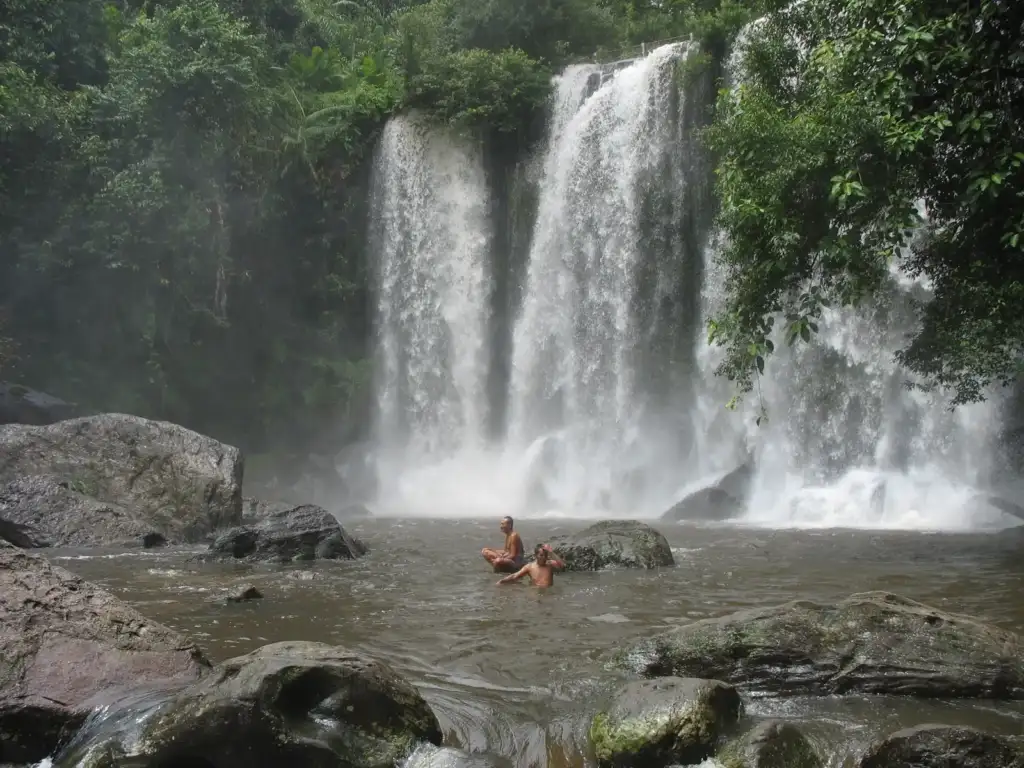
North of Siem Reap, the sandstone hills of Phnom Kulen (ភ្នំគូលែន) are where the Khmer empire began. In 802, King Jayavarman II was proclaimed universal ruler here, and the stone for Angkor’s temples was quarried from its slopes. Today the mountain is a national park and a place of pilgrimage, with waterfalls, a giant reclining Buddha and carvings in the riverbeds. On its northern side, Kbal Spean (ក្បាលស្ពាន) hides more river carvings at the end of a forest walk.
Compare passes, pick a route and find every temple guide in our Angkor travel guide.
The road up Phnom Kulen runs one way: up in the morning, down from about midday. Aim to reach the entrance gate by about 10:30 am. Ticket prices and road times are set locally and can change, so confirm them with your hotel or driver. Details below were checked on 15 November 2026.
Conditions now
Phnom Kulen and Kbal Spean
26°C
Overcast · feels like 30°C
- Humidity 74%
- Wind 5 km/h
- Air: Moderate (AQI 57)
- TodayOvercast32° / 24°28% rain
- WedDrizzle30° / 23°32% rain
- ThuOvercast30° / 21°37% rain
- FriDrizzle31° / 22°49% rain
- SatDrizzle31° / 23°61% rain
Updated hourly. Forecast and air quality by Open-Meteo.com (CC BY 4.0). Conditions can change quickly in the wet season.
The sacred mountain
Phnom Kulen, “mountain of lychees”, is a sandstone plateau about 400 meters high, with its highest point near 500 meters. Inscriptions record that Jayavarman II was consecrated as chakravartin, universal monarch, at Mahendraparvata on this mountain in 802, an event often taken as the founding of the Khmer empire. The sandstone of Angkor Wat and many other temples was quarried here and carried to the plain.
For a long time, Mahendraparvata was known mainly from inscriptions. In 2012, an airborne laser survey led by archaeologists Damian Evans and Jean-Baptiste Chevance scanned the forest from the air and revealed the outline of a 9th-century city beneath the trees: dozens of unknown temples, roads, dykes and reservoirs. The site is now on Cambodia’s UNESCO World Heritage Tentative List.
The mountain is also a living holy place. Cambodians come to pray at its shrines and bathe at its waterfalls, especially on weekends and holidays, when it can be busy.
What to see on Phnom Kulen
The reclining Buddha
At Wat Preah Ang Thom, a 16th-century monastery near the summit, a reclining Buddha about 8 meters long is carved from a single great boulder. It is an active shrine, so remove your shoes before approaching.
River of a Thousand Lingas
At Anlong Pong Phkay, a stretch of riverbed about 500 meters long is carved with lingas, yonis and a large figure of Vishnu, visible through the clear water. Look from the banks and the bridge.
The waterfalls
An upper fall, wide and low, and a lower fall about 15 to 20 meters high with a pool where people swim. Both are fullest in the rainy season and much smaller by the end of the dry months.
Forest and views
The plateau is covered in forest. Most of the ancient city revealed by the laser survey lies hidden under the trees and is not set up for visitors. A few brick temples in the forest, including Prasat Rong Chen, the earliest pyramid temple of the Angkor period, can be reached with a local guide from Anlong Thom village. See them on our temples map.
Kbal Spean
Kbal Spean, “bridgehead”, is a riverbed on the northern side of the Kulen hills, carved in the 11th century. The work began under King Suryavarman I and continued mainly under Udayadityavarman II. Along the stream, the rock is covered with hundreds of small lingas and with Hindu gods: Vishnu reclining on the serpent Ananta, Shiva with Uma, and Brahma. The water flowing over the lingas was believed to be blessed on its way down to the plain.
The carvings were found in 1969 by the French ethnologist Jean Boulbet, but war closed the area until 1989. In 2003 thieves hacked off one of the Vishnu carvings; a replacement now stands in its place.
To reach the carvings, walk about 1.5 to 2 km uphill through the forest from the car park, around 40 to 45 minutes each way, climbing about 100 to 150 meters. The path ends near a small waterfall.
Tickets
Both sites need their own ticket. Neither is part of the main Angkor Pass on the official ticket list.
| Site | Price (foreign visitors) | Where to buy |
|---|---|---|
| Kbal Spean, 1 day | US$5 | Angkor Enterprise, online or at counters; hours 6:00 am–6:30 pm |
| Phnom Kulen, 1 day | US$20 | In cash at the gate at the foot of the mountain, or in advance at an office in Siem Reap |
Prices last checked: 15 November 2026. The Kbal Spean ticket is listed on the official Angkor Enterprise ticket page. The Phnom Kulen fee is set by the local district authority and is not sold by Angkor Enterprise; Cambodian visitors enter free. Confirm both before you go.
When to go
Best months
November to January
The waterfalls still have water after the rains, and the river carvings are easier to see as levels drop. The weather is cooler for the Kbal Spean walk.
Time of day
Early start
Leave Siem Reap by about 8 am so you reach the Kulen gate well before the road switches to downhill traffic.
Avoid
Weekends and holidays
Kulen is a favorite outing for Cambodian families and pilgrims. Weekdays are calmer at the waterfalls and the Buddha.
Getting there
Phnom Kulen is about 48 km north-east of Siem Reap, one to two hours by car depending on the route. Tuk-tuks cannot manage the climb, so hire a car and driver for the day; see getting around Cambodia. From the gate it takes about 20 minutes to drive to the top.
Kbal Spean is reached from the Banteay Srei area, north-east of Siem Reap. The two make an easy half-day together: Banteay Srei in the early morning, then the Kbal Spean walk before it gets hot. Because of the morning road window, Phnom Kulen usually works best as its own day.
Visit safely and respectfully
Phnom Kulen and Kbal Spean are sacred places. Dress modestly, cover shoulders and knees at shrines and remove your shoes where asked. If you swim at the waterfall, wear something modest, as Cambodian visitors do. Do not stand on or touch the carvings in the riverbeds.
The Kulen hills were a battleground until the 1990s, and landmines and unexploded ordnance have not been cleared from every area. Stay on roads and well-used paths, and do not wander off into the forest.
Frequently asked questions
Is Phnom Kulen included in the Angkor Pass?
No. Phnom Kulen has its own entry fee, collected at the foot of the mountain. Kbal Spean is listed as a separate US$5 ticket on the official Angkor Enterprise site.
What time does the Phnom Kulen road open?
The road runs uphill in the morning and downhill from about midday. Reach the gate by about 10:30 am to be safe, and check the current times with your driver.
Is Kbal Spean the same as the River of a Thousand Lingas on Phnom Kulen?
Both are carved riverbeds and both are sometimes called by that name, but they are different sites. Anlong Pong Phkay is on the Kulen plateau; Kbal Spean is on the northern side of the hills, reached by a forest walk.
Can you swim at the Phnom Kulen waterfall?
Yes, at the pool below the lower fall. Swim in modest clothing, and take care on wet rocks.
How long is the walk at Kbal Spean?
About 1.5 to 2 km uphill each way, around 40 to 45 minutes, on a forest path with some steep sections.
Sources: Kbal Spean ticket from Angkor Enterprise; Mahendraparvata survey from Chevance, Evans et al. in Antiquity (2019); Kulen fee as reported by Southeast Asian Archaeology; visiting details from Siem Reap.net and Hello Angkor; history from Wikipedia. Last checked 15 November 2026.