
The Grand Circuit is Angkor’s second classic day: a loop beyond Angkor Thom’s North Gate to temples that feel quieter and more varied than the famous few. In one day you can walk Preah Khan’s long corridors, see a healing-water shrine on an island, pass through a gate swallowed by a fig tree, meet stone elephants on a temple that once stood in a lake, and finish with sunset from the brick terraces of Pre Rup.
Compare passes, pick a route and find every temple guide in our Angkor travel guide.
Opening hours differ slightly between temples and have changed in recent years. Most Grand Circuit temples open from about 7:00 am to 6:30 pm, and Pre Rup stays open later for sunset, until about 7:00 pm. Restoration work can close small areas. Details below were checked on 17 November 2026; confirm at the ticket office or with your driver.
Conditions now
Angkor Grand Circuit
28°C
Overcast · feels like 31°C
- Humidity 71%
- Wind 7 km/h
- Air: Moderate (AQI 57)
- TodayOvercast34° / 24°28% rain
- WedDrizzle31° / 25°32% rain
- ThuDrizzle32° / 23°37% rain
- FriDrizzle33° / 24°49% rain
- SatDrizzle32° / 25°61% rain
Updated hourly. Forecast and air quality by Open-Meteo.com (CC BY 4.0). Conditions can change quickly in the wet season.
The temples, in route order
1. Preah Khan
The loop usually begins at Preah Khan, Jayavarman VII’s great Buddhist temple-city of 1191, with giant garudas on its outer wall and long corridors running east to west. It deserves its own visit; see our Preah Khan guide.
2. Neak Pean (ប្រាសាទនាគព័ន្ធ)
Neak Pean, “entwined serpents”, is a small shrine on an island in the middle of the Jayatataka, the reservoir that once lay east of Preah Khan. Built under Jayavarman VII in the late 12th century, it recreates a sacred lake in the Himalayas known for healing waters: a square central pool with a round islet and shrine, and four smaller pools around it. Water once flowed into the side pools through spouts carved as the heads of an elephant, a horse, a lion and a human, and pilgrims bathed there hoping to be cured.
In the central pool, look for the horse Balaha, a form of the compassionate Lokeshvara, carrying shipwrecked sailors to safety. Visitors walk out on a long causeway and view the pools from the edge; allow about 30 minutes.
3. Krol Ko (ប្រាសាទក្រោលគោ), a short stop
Opposite the Neak Pean path, the small Buddhist temple of Krol Ko, “park of the oxen”, has pediments carved with Lokeshvara and with Krishna lifting Mount Govardhana. It takes about ten minutes and is usually quiet.
4. Ta Som (ប្រាសាទតាសោម)
Another of Jayavarman VII’s foundations, Ta Som has gateways crowned with the calm four-faced towers seen at the Bayon. Its best-known sight is at the far end: the eastern gate, where the roots of a huge fig tree have wrapped around the stone. Walk through the temple from west to east to finish there. The World Monuments Fund has helped conserve Ta Som since 1998.
5. East Mebon (ប្រាសាទមេបុណ្យខាងកើត)
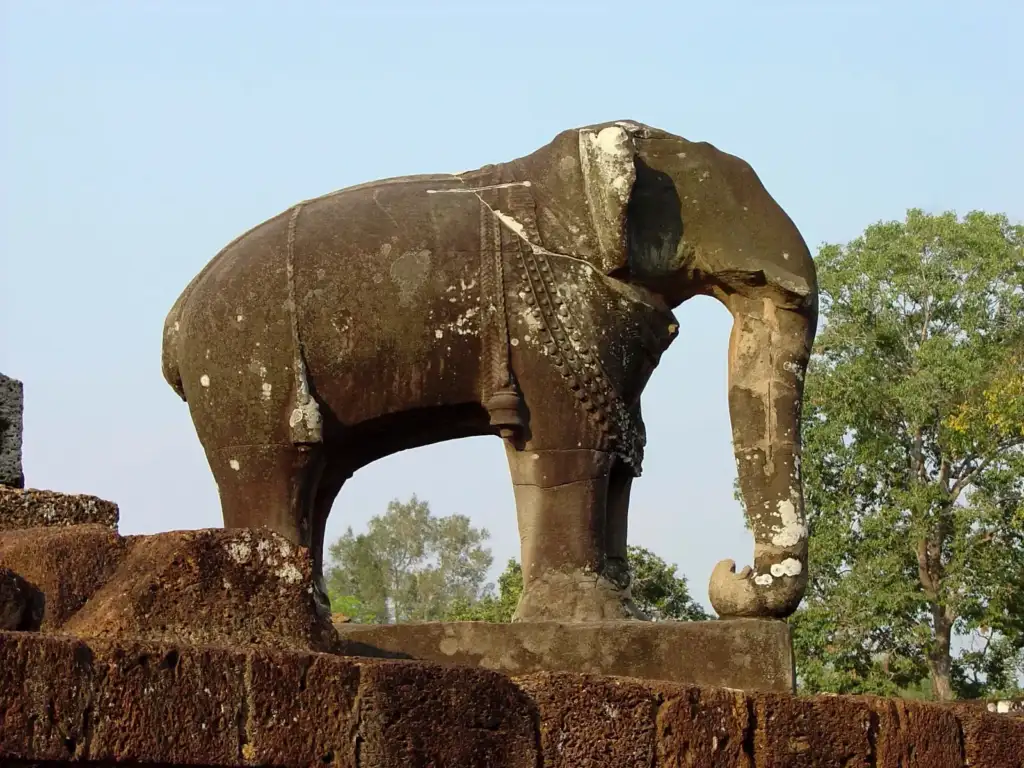
Dedicated to Shiva by King Rajendravarman in 952 or 953, East Mebon was built on an island in the middle of the East Baray, a reservoir 7 km long that could only be crossed by boat. The water is long gone, but the four landing stages remain. Stone elephants, carved from single blocks, stand at the corners of the lower terraces, and the brick towers are pitted with small holes that once anchored a layer of carved plaster.
6. Pre Rup (ប្រាសាទប្រែរូប)
Pre Rup, Rajendravarman’s state temple of 961, rises in three tiers of laterite and brick to five towers, which glow deep red in the late afternoon. Its modern name means “turning the body”, from a belief that cremations were held here; scholars doubt it. It is the circuit’s classic sunset spot. After safety repairs, sunset viewing reopened in 2024, with handrails added on the steep stairs.
Optional: Banteay Samre
About 400 meters beyond the eastern edge of the East Baray, Banteay Samre is a beautifully restored 12th-century Hindu temple in the style of Angkor Wat, with fine carving and few visitors. It adds a short drive east of Pre Rup.
Tickets
All the temples in this guide, including Banteay Samre, are inside the Angkor Archaeological Park and covered by every Angkor Pass. Keep your pass with you for checks at each temple.
| Pass | Price (foreign visitors) | Validity |
|---|---|---|
| 1 day | US$37 | One day |
| 3 days | US$62 | Any three days within 7 days |
| 7 days | US$72 | Any seven days within 30 days |
Prices last checked: 17 November 2026. Confirm the current price on the official Angkor Enterprise site. The Angkor Wat guide explains where to buy.
Plan your day
Full day
Clockwise
Start at Preah Khan in the morning, then Neak Pean, Krol Ko and Ta Som. Rest at midday, then East Mebon and sunset at Pre Rup.
Half day
Afternoon and sunset
Ta Som, East Mebon and Pre Rup from about 2:00 pm, ending with sunset. Save Preah Khan for another morning.
Compared
Small Circuit
The Small Circuit covers Angkor Wat, the Bayon and Ta Prohm. Do it first, then the Grand Circuit on your second day.
Getting around
Traced on the roads, the loop is about 26 km starting and ending at Angkor Wat, plus about 6 km each way from central Siem Reap. Most visitors hire a tuk-tuk or car with a driver for the day; cycling is possible on the flat roads if you start early. See getting around Cambodia and our first-time guide to Angkor for full routes.
Visit with care
Pre Rup and East Mebon have steep, uneven stairs; use the handrails where they exist and take care coming down after sunset. Stay on the causeway at Neak Pean, do not climb on fallen stones or carvings, and cover shoulders and knees at every temple. Carry water: there is little shade between Ta Som and Pre Rup.
Frequently asked questions
Which temples are on the Grand Circuit?
Preah Khan, Neak Pean, Ta Som, East Mebon and Pre Rup, with smaller stops such as Krol Ko. Banteay Samre is a popular extension.
Is the Grand Circuit worth it?
Yes, especially on a second day. It is quieter than the Small Circuit and more varied, from an island shrine to a temple-mountain at sunset.
Where is the best sunset on the Grand Circuit?
Pre Rup. Arrive at least 45 minutes before sunset for a place on the upper terraces.
How long does the Grand Circuit take?
A full day at a relaxed pace, or about four hours of temple time plus the drive if you keep moving.
Sources: temple histories and dimensions from Maurice Glaize’s Angkor guide (Neak Pean, Ta Som, East Mebon, Pre Rup, Krol Ko) and Wikipedia; hours from Angkor Enterprise and Le Petit Journal; Neak Pean works from Cambodianess; Pre Rup repairs from Southeast Asian Archaeology; route distances from Hello Angkor. Last checked 17 November 2026.