
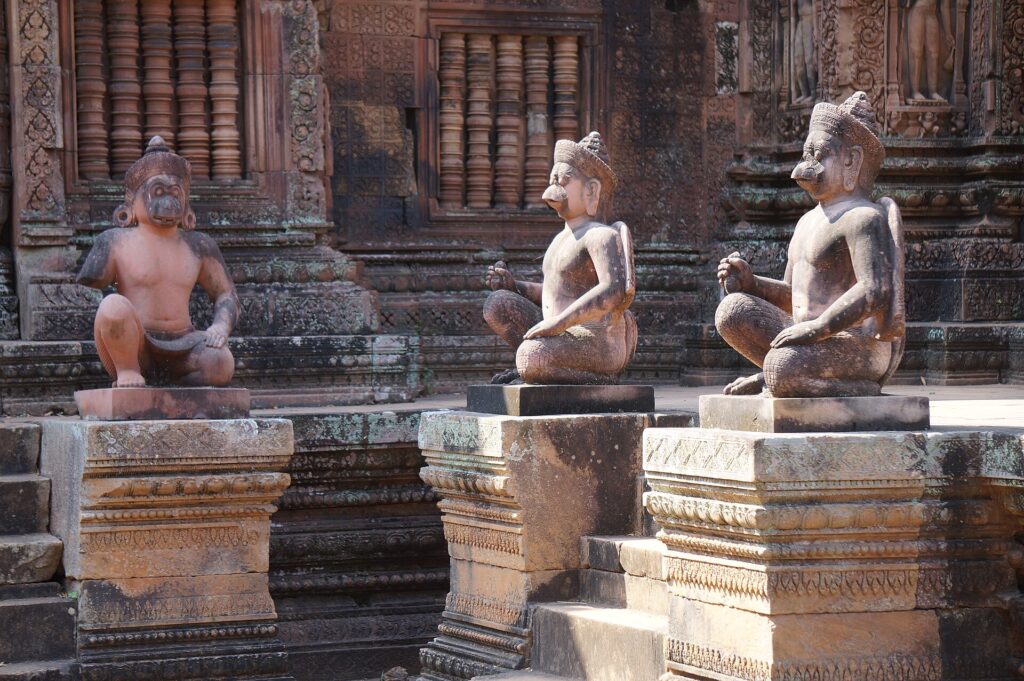
Banteay Srei is smaller than Angkor’s great state temples, yet its fine carving and warm-toned sandstone make close looking especially rewarding. Its distance from the main circuit encourages a different kind of day, with countryside, villages and quieter stops along the way.
Compare passes, pick a route and find every temple guide in our Angkor travel guide.
Opening hours, walkways and restricted areas are set by the APSARA National Authority and can change with conservation work or ceremonies. The details below were checked in September 2026; follow signs and staff directions on the day.
Conditions now
Banteay Srei
29°C
Overcast · feels like 35°C
- Humidity 82%
- Wind 4 km/h
- Air: Good (AQI 34)
- TodayThunderstorms31° / 24°84% rain
- FriThunderstorms31° / 24°78% rain
- SatThunderstorms31° / 24°63% rain
- SunShowers31° / 23°63% rain
- MonDrizzle30° / 24°70% rain
Updated hourly. Forecast and air quality by Open-Meteo.com (CC BY 4.0). Conditions can change quickly in the wet season.
Why it is distinctive
Banteay Srei was consecrated in 967 CE, about 150 years before Angkor Wat. Unusually, it was not a royal foundation: it was built by Yajnavaraha, a Brahmin scholar and counsellor to King Rajendravarman, and dedicated mainly to Shiva. The name by which it is known today, often translated as “citadel of women”, is later and probably refers to the delicacy of its decoration rather than its original purpose.
The temple is built of fine-grained pink sandstone, which allowed carvers to cut deep, crisp relief across lintels, pediments and walls. Its scale should not be described as less important; it changes how a visitor encounters lintels, pediments, guardians and narrative detail.
A history of loss and care
Banteay Srei was rediscovered by French surveyors in 1914. In 1923 the young André Malraux, later France’s minister of culture, was arrested for removing devata carvings from the site; they were returned. The case helped strengthen protection for Angkor. In the early 1930s the temple became the first at Angkor restored by anastylosis, a method of dismantling and rebuilding with original stones. Later conservation work, including a Cambodian–Swiss project in the early 2000s, improved drainage and visitor management.
Tickets
Entry is included in the Angkor Pass; there is no separate ticket. The pass is checked at the entrance, so keep it with you (and a passport for any child under 12, who enters free). Kbal Spean nearby and Beng Mealea are sold as separate passes (US$5 and US$10 on the official site), and Phnom Kulen has its own ticket.
| Pass | Price (foreign visitors) | Validity |
|---|---|---|
| 1 day | US$37 | One day |
| 3 days | US$62 | Any three days within 7 days |
| 7 days | US$72 | Any seven days within 30 days |
Prices and validity last checked: 15 October 2026. Angkor Pass prices can change. Confirm the current price on the official Angkor Enterprise site before you buy. The Angkor Wat guide explains where to buy and the sunset rule.
Getting there
Banteay Srei is about 35 km north-east of central Siem Reap, roughly an hour by tuk-tuk and a little less by car, on a good road through rice fields and villages.
Tuk-tuk
Pleasant for the countryside, but a long ride in the heat. Expect to pay more than a small-circuit day, often around US$10–15 extra. Agree the price and stops in advance.
Car
More comfortable in the hot or rainy season and quicker if you are combining several distant sites in one day.
A visitor area near the entrance has toilets, food stalls and information panels. The temple is reached along a short path from there.
What to look for
Central sanctuary
Ravana shakes Mount Kailasa
On a pediment near the center, the demon king Ravana shakes Shiva’s mountain home while Shiva and Parvati sit calmly above. It is one of the best-known Khmer carvings.
Guardians and devatas
Figures in niches
Graceful devatas and monkey-headed or human guardian figures stand in niches around the central towers. Many are replicas; originals are in the National Museum in Phnom Penh.
Lintels and pediments
Layered stories
Look for Indra on his three-headed elephant, Vishnu as a man-lion, and scenes from the Ramayana, framed by dense scrolling foliage.
The inner sanctuary is roped off to protect it, so bring a zoom lens or binoculars if you want to study the finest details. Compare repeating door frames, carved foliage, divine figures and narrative scenes, and do not let identification replace close looking.
When to go
Early
Before 10:00 am
Calmer and cooler, with good light on east-facing carvings. Leave Siem Reap by about 7 am.
Midday
Busiest and hottest
Tour groups often arrive late morning, and there is little shade within the enclosure.
Late afternoon
After 3:00 pm
Groups thin out and the stone glows warm in the lower light.
Build a day around it
Combine Banteay Srei with countryside stops chosen for genuine interest, not simply because they are sold together. Distance should be checked before adding too much; choose fewer stops when heat, children or mobility make a long day tiring.
Kbal SpeanA forest walk of about 45 minutes uphill to riverbed carvings of lingas and Hindu deities, around 13 km further north. Go in the morning; access can close in the afternoon.
Cambodian Landmine MuseumA few kilometers away, founded by a former child soldier turned deminer. A sober, important context for the countryside you drive through.
Banteay Samre and Pre RupOn the road back toward Siem Reap. Pre Rup is a popular sunset spot to finish the day.
Practical respect
- Follow current one-way routes and restricted areas.
- Do not touch carvings or lean on the masonry.
- Keep tripods and bags from blocking narrow passages.
- Dress for a sacred heritage site: shoulders and knees covered.
- Use qualified guides when you want confident interpretation of imagery.
Frequently asked questions
Is Banteay Srei worth the drive?
For most visitors, yes, especially on a second day. It is the finest showcase of Khmer carving at Angkor, and the drive shows rural life around Siem Reap.
Is Banteay Srei included in the Angkor Pass?
Yes. Your pass is checked at the entrance.
Why is it called the “pink temple”?
It is built of a fine pink sandstone that looks warmest in early morning and late afternoon light.
How long does a Banteay Srei trip take?
A half-day for the temple alone, including travel; a full day with Kbal Spean and stops on the way back.
Official references: Angkor Enterprise (official Angkor Pass sales), APSARA National Authority visitor information and the UNESCO World Heritage Centre: Angkor. Hours and access were checked in September 2026 and should be confirmed again shortly before travel. Transport and guide prices are indicative ranges from published driver price lists, not official fares; agree the price with your driver.