
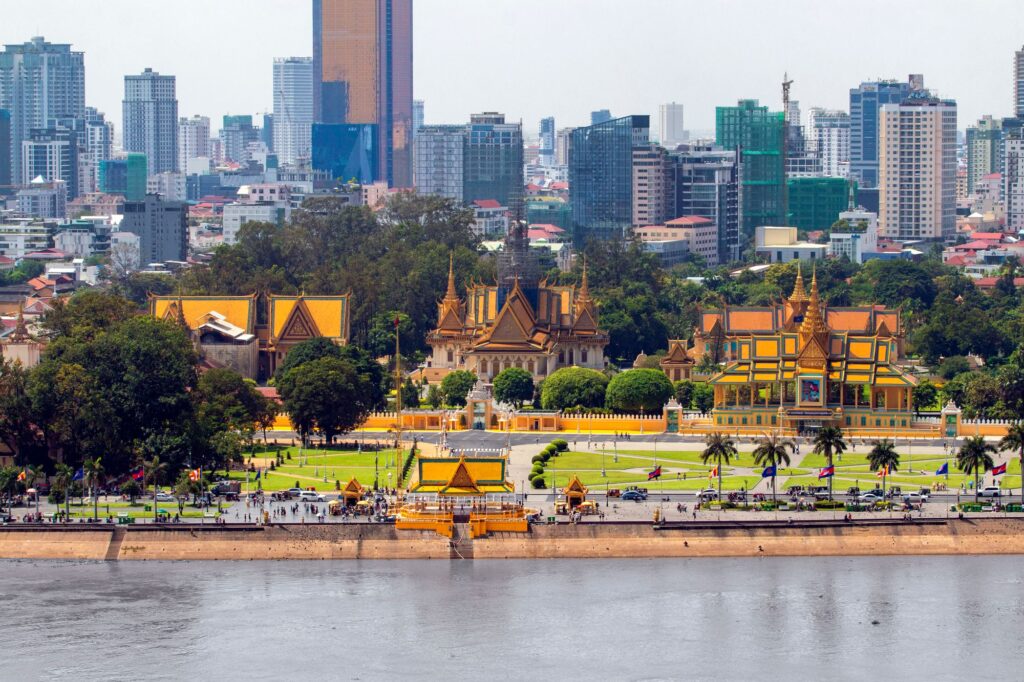
Phnom Penh is where Cambodia’s rivers, royal heritage, markets, food and fast-changing urban life meet. The capital can feel energetic at first, but its most rewarding experiences unfold at street level: an early walk beside the Tonlé Sap, a quiet museum courtyard, lunch in a neighborhood restaurant, and an evening watching boats move across the water.
Why visit Phnom Penh
Phnom Penh gives a different view of Cambodia from the temples of Angkor or the southern coast. It is a living capital rather than a preserved historic centre. Golden-roofed landmarks, Buddhist pagodas and French-era buildings share the city with contemporary galleries, cafés, apartment towers and crowded commercial streets.
For first-time visitors, the city adds essential context to a longer Cambodian journey. It is also a destination in its own right for people interested in Khmer art, architecture, food, photography and everyday urban culture.
Essential experiences
Begin around the Royal Palace and National Museum
The Royal Palace, Silver Pagoda and National Museum form Phnom Penh’s principal cultural cluster. The palace complex introduces formal Khmer architecture and royal traditions, while the museum’s courtyards and galleries bring together important works of Cambodian sculpture and archaeology.
Opening arrangements can change for ceremonies and official functions, so check locally before visiting. Dress respectfully, covering shoulders and knees, and follow photography restrictions inside buildings and galleries.
Walk the riverfront at different times of day
Phnom Penh stands where the Mekong, Tonlé Sap and Bassac waterways meet. The riverside is most atmospheric in the early morning and late afternoon, when residents exercise, families gather, vendors set up and the heat becomes gentler.
A short sunset cruise offers a wider view of the city and the river junction. Choose an established operator, confirm the route and price before boarding, and avoid treating the cruise as a substitute for exploring the neighborhoods on foot.
Explore markets and local food
Central Market is known for its distinctive Art Deco structure, while Russian Market and neighborhood markets offer a more layered mix of food, household goods, clothing and souvenirs. Markets are working public spaces; keep valuables secure, ask before photographing people and make room for shoppers and vendors.
Phnom Penh’s food scene ranges from breakfast stalls and family-run Khmer restaurants to bakeries, modern Cambodian kitchens and regional Southeast Asian cooking. Try several smaller meals across the day rather than relying only on the riverfront’s most visible restaurants.
Visit Wat Phnom and nearby streets
Wat Phnom sits on the small hill associated with the city’s founding story. The temple is compact, but the shaded grounds and nearby streets provide a useful transition between the riverfront, older commercial quarters and the northern centre.
Keep voices low inside the sanctuary, dress appropriately and avoid interrupting worship. Monkeys may occasionally appear around the grounds; do not feed or approach them.
Approach Cambodia’s memorial sites thoughtfully
Tuol Sleng Genocide Museum and Choeung Ek are places of remembrance, education and mourning. They document mass violence and personal loss, and they can be emotionally difficult. Allow time, avoid rushing both sites into an already crowded day, and decide in advance whether the experience is appropriate for children in your group.
Photography should never become performative. Follow site guidance, speak quietly, do not photograph human remains where prohibited, and avoid casual poses or social-media behavior that diminishes the dignity of victims and survivors.
How many days to spend
Two full days provides a useful introduction: one day for the palace, museum, riverfront and markets, and another for deeper historical context and neighborhood exploration. Three days allows a more comfortable pace, extra food experiences and time for galleries, architecture or a river journey.
If Phnom Penh is your arrival point after a long international flight, add a lighter first day rather than beginning immediately with the city’s most demanding museum visits.
When to visit
November through February generally brings drier and relatively cooler conditions, making longer walks easier. March and April are commonly hotter. From roughly May through October, the city is greener and afternoon rain can be heavy, although substantial parts of many days remain usable.
The riverfront and outdoor landmarks are most comfortable early or late in the day. Plan museums, cafés or a midday rest during the hottest hours, carry drinking water and use sun protection throughout the year.
Getting there and around
Techo International Airport serves Phnom Penh. Road and rail services connect the capital with Siem Reap, Battambang, Kampot, Sihanoukville and other Cambodian destinations, while international road links reach Vietnam and Thailand. Schedules change, so confirm current services directly with operators.
Within the city, remorks, taxis and app-arranged vehicles are practical for most trips. Walking works well within individual areas, but distances between major sights are larger than they appear and road crossings demand attention. Use marked crossings where available, move predictably and do not assume vehicles will yield.
A balanced first visit
Start early with the Royal Palace area and National Museum, then pause for lunch away from the hottest part of the day. Continue with Wat Phnom or a market, and finish at the riverfront as the city becomes more social.
On a second day, choose either the memorial sites or a slower exploration of food, art and neighborhoods. Avoid combining every major museum and memorial into one exhausting sequence. Leave an evening open for a relaxed meal and a walk rather than filling every hour.
Practical planning notes
- Check current opening arrangements directly with each attraction before visiting.
- Dress with shoulders and knees covered for the Royal Palace and active religious sites.
- Carry small amounts of cash.
- Use reputable transport and confirm the destination before the journey begins.
- Build routes by neighborhood to reduce unnecessary time in traffic.
- Treat memorial sites as places of remembrance, not conventional sightseeing stops.
Featured image: Phnom Penh’s Royal Palace and city skyline by Piseth Mao, via Pexels.